

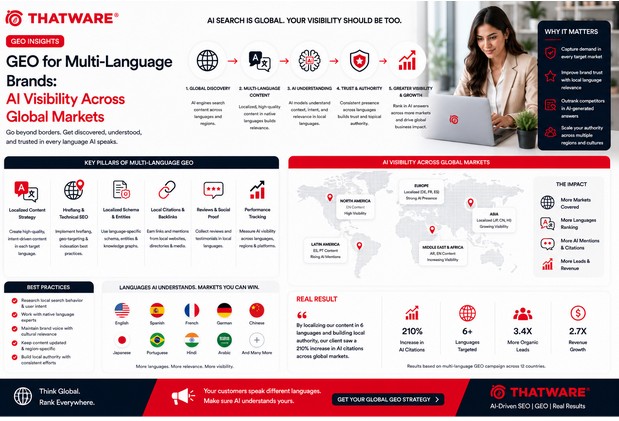
Running a global brand is complicated under the best circumstances. You’re managing multiple markets, multiple languages, multiple cultural contexts, and multiple regulatory environments — all while trying to maintain enough brand coherence that you actually seem like one company. The marketing function alone could occupy an army.
Generative Engine Optimization adds another layer to this complexity, and it’s one that most global brands haven’t fully addressed yet. The AI visibility challenges in a multi-language, multi-market context are distinct from those in a single-market program — different AI tools dominate different regions, AI systems have different levels of training data quality across languages, and entity optimization needs to work across multiple language contexts simultaneously.
Getting this right is genuinely complex. But the brands that do get it right have an advantage that’s hard to replicate quickly.
The Multi-Language AI Landscape
The AI tools dominant in search and information discovery vary significantly by region. In North American and UK markets, ChatGPT, Perplexity, Google AI Overviews, and Bing Copilot dominate. In other markets, the landscape is different — regional AI tools, local search AI features, and different levels of AI search penetration all affect where you need to show up.
This means a global GEO strategy can’t simply be an English-language strategy translated. It requires understanding which AI tools matter in each priority market and how they evaluate brand authority in the relevant language and context.
The quality of AI training data also varies significantly across languages. English-language content has the deepest AI training data coverage; major European languages are well-represented; many other languages have thinner coverage, which means the standards for what constitutes authoritative citation content may be different. A brand that dominates AI citations in German may face a different competitive landscape than one competing for English citations.
Entity Consistency Across Languages
One of the most common and impactful GEO problems for global brands is entity inconsistency across language versions of their digital presence.
Your brand name may be the same in English and French, but your company description, area of expertise, and key personnel might be described differently on your French site versus your English site. Your LinkedIn company page — often a global entity — may not reflect local market positioning. Your local press coverage in different markets may describe your brand in ways that conflict with each other.
AI systems trying to build a confident entity understanding of your brand across multiple language contexts encounter these inconsistencies and resolve them by either forming a fragmented entity understanding or defaulting to the market with the strongest, most consistent signals (usually English) for all markets.
Enterprise GEO optimization agency work for global brands typically begins with a multi-language entity audit — identifying the specific inconsistencies across markets and developing a plan to create the coherent global entity presence that AI systems can reliably work with.
Hreflang and International SEO as GEO Foundation
The technical infrastructure for international SEO — hreflang tags, language-specific sitemaps, geo-targeting signals — also matters for GEO. AI systems that crawl and index your content need clear signals about which version of your content is authoritative for which market.
Brands with mature international SEO implementations have a meaningful head start on the technical GEO foundation for global markets. Brands that have underinvested in international technical SEO often find that their GEO challenges in non-English markets are compounded by technical accessibility issues — the AI simply can’t efficiently access and attribute local language content.
This is foundational work before more advanced GEO optimization. Get the technical layer right, then build the content and citation strategy on top of it.
Market-Specific Content Strategy
For GEO purposes, content that’s relevant to a specific market should be produced and published with that market’s AI citation context in mind — not just translated from English.
This matters because buyer questions, regulatory contexts, competitive landscapes, and cultural reference points vary across markets. An AI answering “what accounting software is best for small businesses in Germany” is drawing on German-language content about German regulatory requirements, German market context, and German user experiences. A translated English-language product page doesn’t answer those questions the way market-specific content does.
Brands that invest in genuinely localized content — not just translated content — build meaningfully stronger GEO positions in local markets.
Building Local Citation Authority
External citation signals — the third-party references that feed AI authority building — are market-specific. An earned media placement in a US publication does limited work for your GEO authority in Japan. Building AI citation authority in a market requires building external citation authority in that market’s authoritative sources.
For major European markets with well-developed digital media ecosystems, this looks similar to the English-language PR and digital outreach work — targeting authoritative local publications, building relationships with regional media, and contributing to local industry discussions. For markets with thinner digital media ecosystems, the approach needs to adapt — perhaps focusing more on industry associations, local event presence, and regional analyst relationships.
Generative Engine Optimization agency near me searches are common from global brands looking for partners with regional expertise — and it’s a reasonable thing to prioritize. An agency with genuine in-market expertise in your priority regions will understand the local citation landscape in ways that a purely English-language practice won’t.
The Compounding Advantage of Early Global GEO Investment
Most brands in most global markets are behind on GEO. The field is younger outside English-language markets, the available expertise is thinner, and fewer brands have made deliberate investments in AI citation authority in regional contexts.
This means the first-mover advantages available in GEO are even more pronounced in non-English markets. A brand that builds genuine AI citation authority in German, French, Spanish, or Japanese markets over the next twelve to eighteen months is competing in a less crowded field than one fighting for English-language citations.
For global brands with meaningful revenue stakes in multiple regions, the ROI case for early multi-language GEO investment is compelling — not just because the opportunity is real, but because the window to build unchallenged early authority is narrower than it might appear.
Global brands that get multi-language GEO right aren’t just building AI visibility in one market. They’re building a compounding authority advantage across every market they operate in — and that compounds differently than any single-market investment.